
While You’re Paying Per Click, Your Smartest Competitor Is Getting the Same Leads for Free
That’s not a theory. It’s what’s happening in local search right now.
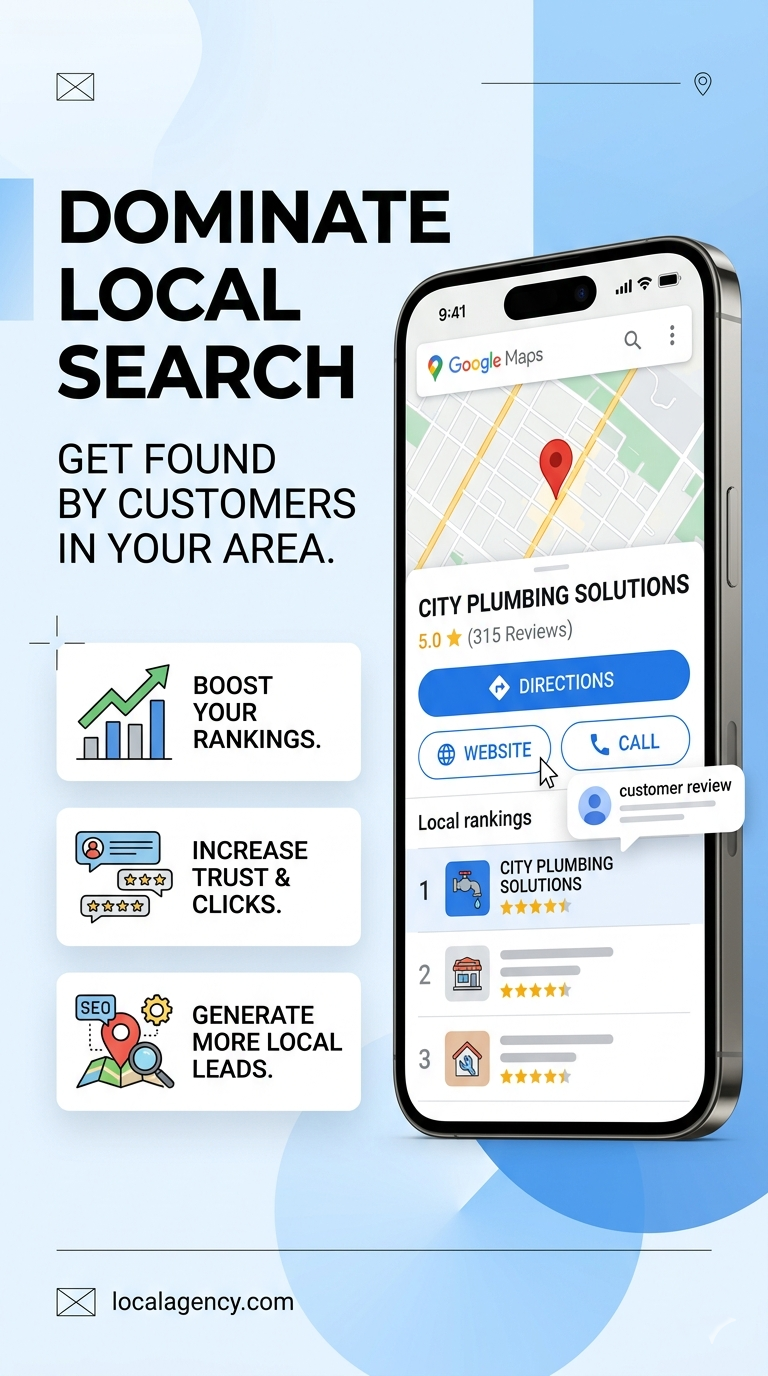
Open Google and search for any local service in your category. Look at the three businesses in the Map Pack at the top. Those businesses are receiving calls, direction requests, and website visits right now, at this moment without paying Google a single dollar for that visibility.
Meanwhile, businesses spending hundreds or thousands per month on Google Ads get a listing that appears above the Map Pack with a small “Sponsored” label a label that increasing numbers of consumers consciously scroll past because they’ve learned to distrust paid results.
Here’s what makes this particularly striking: the organic Map Pack positions often convert better than paid ads. Consumers trust them more. The intent alignment is stronger. The leads are warmer.
And in 2026, with cost-per-click in competitive local categories reaching levels that make many campaigns unprofitable, the businesses that figured out organic Google Maps dominance aren’t just saving money they’ve built a competitive moat that paid advertising simply cannot replicate.
This guide is about how to build that moat.
Not with generic advice you’ve already heard. Not with a checklist of obvious tasks. With a genuine strategic framework the kind that separates the businesses quietly owning their local market from the ones perpetually burning budget trying to keep up.
Prime Growth Digital has helped local businesses across competitive markets stop depending on ads and start owning their Maps positions. This is what we’ve learned.
Can You Actually Rank #1 on Google Maps Without Running Ads?
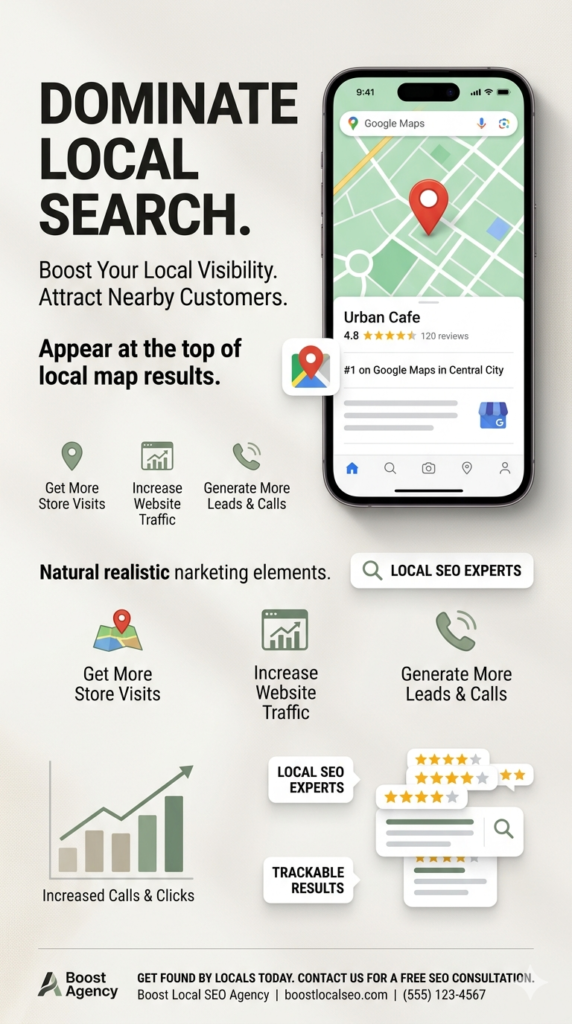
Yes absolutely, and in most local markets, organic Google Maps rankings are more valuable than paid ad positions.
Google Maps rankings are determined by three algorithmic factors: relevance (how well your business matches the search), distance (how close you are to the searcher), and prominence (how authoritative and trustworthy your business appears across the web).
None of these factors are influenced by ad spend. They’re influenced by strategic, sustained optimization of your Google Business Profile, review profile, citation authority, and website quality.
Businesses that rank #1 on Google Maps in 2026 without ads have built genuine local digital authority and that authority generates free leads every day, indefinitely, without a monthly budget attached.
The Ad Spend Trap That Most Local Businesses Can’t See They’re In
Here’s a conversation that happens more than you’d think.
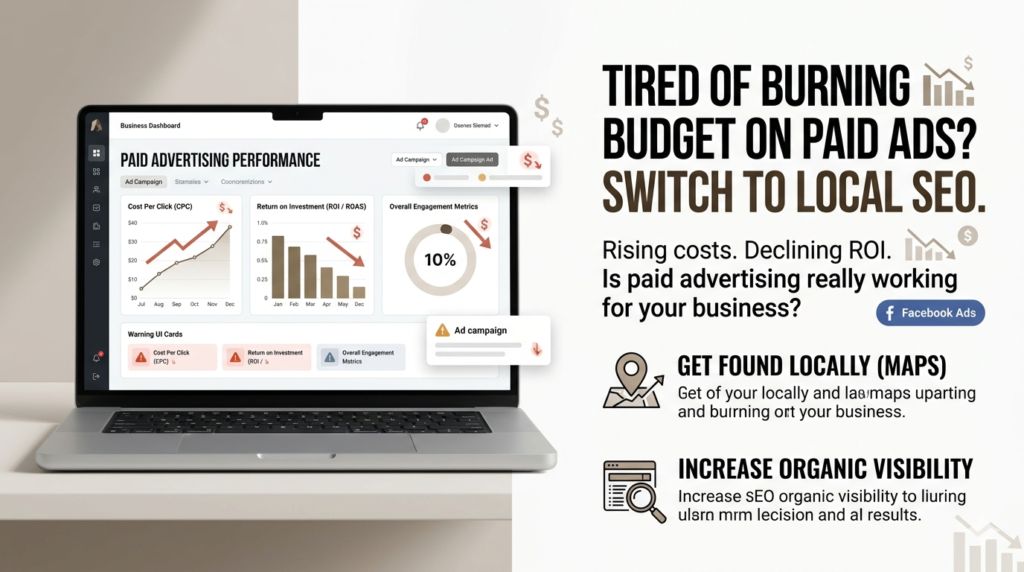
A business owner is spending $3,000 a month on Google Ads. The leads come in. The phone rings. The business looks like it’s working. Then the ad budget gets cut maybe a slow month, maybe a cash flow pinch, maybe just a decision to reassess and the phone goes silent.
Not quieter. Silent.
Because the entire digital presence was rented, not owned. The moment the payment stopped, the visibility stopped. There was nothing underneath the ads no organic foundation, no Maps presence, no local authority that continued working when the budget didn’t.
This is the ad spend trap. It’s not that ads are inherently bad. It’s that ads without a parallel organic strategy create a dependency that becomes increasingly expensive and increasingly fragile over time.
The alternative isn’t difficult to understand conceptually: build genuine local authority so that Google’s algorithm recommends your business to local searchers without you paying for each recommendation. In practice, that means mastering Google Maps SEO in 2026 the specific set of signals that determine Map Pack rankings.
This guide covers exactly how to do that, step by step, with the strategic depth that most generic local SEO content deliberately avoids.
Why Most Local Businesses Are Invisible on Google Maps (And Why It’s Not Their Fault)
Most business owners are experts in their trade. They are not and shouldn’t have to be experts in local search algorithm behaviour.
So when they set up a Google Business Profile, add their address and phone number, upload a few photos, and wait for results and nothing significant happens they assume the platform doesn’t work for their business. Or that they need to pay for ads. Or that their competitors must have some advantage they can’t access.
None of those conclusions are usually correct.
The actual reasons for Maps invisibility are specific, fixable, and once you understand them obvious:
They chose the wrong primary category. This single decision has more influence on Maps ranking than almost any other profile element. “Contractor” is not the same as “kitchen renovation contractor.” “Restaurant” is not the same as “authentic Thai restaurant.” Specificity wins.
Their profile is incomplete at the detail level. It looks filled out name, address, hours. But the Services section is empty. The Q&A section has no content. The business description is three generic sentences. The attributes relevant to their business type are unchecked. Every empty field is a missed signal.
They have reviews, but no review system. They got a burst of reviews when they launched, then nothing for months. Google interprets stagnant review profiles as signals of decreased business activity and ranks accordingly.
Their profile is inactive. No posts in four months. Same six photos from two years ago. Google watches activity signals continuously. An inactive profile, in a competitive category, gradually loses ground to competitors who are consistently engaged.
Their website is locally invisible. The website linked from their GBP has no local landing pages, no city-specific content, loads in six seconds on mobile, and has no local schema markup. The website actively undermines the Maps ranking rather than supporting it.
Every single one of these problems is fixable. And fixing them with strategic intent rather than checkbox mentality is how local businesses rank #1 on Google Maps in 2026 without spending a dollar on ads.
How Google Maps Actually Decides Who Ranks in 2026
Understanding the algorithm isn’t about finding loopholes. It’s about understanding what Google is trying to accomplish so you can genuinely align with it.
Google Maps exists to give searchers the best possible local recommendation for their specific query from their specific location. Google’s reputation depends on the quality of those recommendations. Every algorithm update is oriented toward making those recommendations more accurate, more trustworthy, and more useful.
The three core ranking factors relevance, distance, and prominence each map to a specific strategic domain:
Relevance: Does Google Understand What Your Business Does?
Relevance is about signal clarity. How unambiguously does Google understand what your business offers, for whom, and where?
Your primary category is the loudest relevance signal. Your secondary categories expand that signal. Your services section deepens it. Your business description reinforces it. The keywords that appear naturally in your reviews add further confirmation. Your website’s local content corroborates everything.
When all these signals align clearly and consistently around a specific set of services and locations, Google has high confidence in your relevance for related searches. When they’re vague, inconsistent, or incomplete, that confidence drops and so do your rankings.
Distance: The Factor You Can’t Control But Can Work Around
Distance is calculated from the searcher’s location to your business address (or the centre of your service area). You can’t move your business to rank for more searches.
What you can do is configure your service area accurately and build local relevance signals for every geographic area you genuinely serve. Location-specific pages on your website, geo-tagged photos, locally relevant review content, and city-specific Google Posts all contribute to your geographic relevance beyond your primary address.
Prominence: The Factor That Separates the Top 3 From Everyone Else
Prominence is Google’s assessment of how well-known, trusted, and reputable your business is both online and in the broader world.
In 2026, prominence is built through:
- Review authority: Volume, recency, rating, and response rate
- Citation consistency: Your business information appearing accurately across authoritative directories
- Website authority: The quality, speed, and local relevance of your linked website
- Backlink profile: Other websites linking to yours, particularly locally relevant ones
- Behavioral signals: How often people click your profile, call your number, and request directions
- Profile activity: How consistently you post, add photos, and update your information
Prominence is the factor that most directly separates the Map Pack top three from the long tail of businesses below and it’s the factor that strategic, sustained local SEO most directly improves.
The Step-by-Step Strategy to Rank #1 on Google Maps in 2026
Step 1 — Audit Your Current Position Before Touching Anything
This step is skipped by almost every generic SEO guide. It’s the most important one.
Before optimising your Google Business Profile, you need to understand exactly where you stand. What searches are you currently appearing for? Where do you rank for your primary target terms? What does your review profile look like in comparison to the top three businesses in your category? What’s your NAP consistency score across your citation footprint?
Without this baseline, you’re optimising blindly and you can’t measure whether your efforts are working.
Spend time mapping this before you touch a single profile element. The audit shapes the strategy. The strategy shapes the execution. Execution without strategy is just expensive activity.
Step 2 — Get Your Primary Category Precisely Right
If you do nothing else from this guide, do this.
Review the complete list of Google Business Profile primary categories available in your business type. Find the most specific, most accurately descriptive category for your primary service.
“Plumber” vs “licensed plumber.” “Lawyer” vs “personal injury attorney.” “Doctor” vs “sports medicine physician.” The more specific the category, the less competition you face and the more precisely you match high-intent searches.
Then add every accurate secondary category available. Each one expands your ranking potential without diluting your primary category signal. Use all nine available slots if you can fill them accurately.
Step 3 — Build a Complete, Strategically Written Profile
Work through every field in your Google Business Profile with this question in mind: “Is this field sending the strongest possible relevance signal for my target searches?”
Business description: Write 750 words of the available 750. Structure it around what your ideal customer needs to know what you do specifically, who you serve, what differentiates you, and where you operate. Incorporate your primary service keywords and location naturally. No keyword stuffing, no generic platitudes.
Services section: List every individual service you offer, each with its own description. The description for “Emergency Boiler Repair” should be different from “New Boiler Installation.” These descriptions are indexed content treat them accordingly.
Products section: If relevant to your business, populate the Products section as thoroughly as the Services section. Each product listing adds additional indexed content and relevance signals.
Q&A section: Seed this yourself with the ten questions your customers ask most frequently. Answer each one specifically and helpfully. This content is indexed by Google, visible to potential customers, and can be the deciding factor for someone comparing two similar businesses.
Attributes: Check every applicable attribute. “Free consultation,” “veteran-owned,” “women-led,” “accepts insurance,” “online appointments” each attribute is a potential filter in Google Maps search, and each filter is a potential traffic source.
Step 4 — Build a Review System, Not Just a Review Habit
The businesses in the Map Pack with 80, 100, or 150 reviews didn’t get there through hope. They built systems.
A review system is an embedded, semi-automated process that consistently generates review requests at the optimal moment in every customer relationship typically immediately after a positive experience, when satisfaction is highest and recall is freshest.
The components of an effective review system:
The request moment: Identify exactly when in your customer journey to make the request. For a contractor, it’s right after project completion during the sign-off conversation. For a dentist, it’s in the post-appointment follow-up. For a restaurant, it might be a QR code on the receipt. The timing should feel natural, not transactional.
The frictionless path: Most customers who intend to leave a review never do because the process felt like too much effort. A direct link that opens Google’s review form shared via SMS, email, or QR code removes every obstacle between intention and action.
The follow-up sequence: A single request generates a fraction of the reviews that a polite, timed follow-up sequence generates. One request at the moment of service, one follow-up 48 hours later if no review has been received. Two touchpoints is typically the sweet spot between effective and intrusive.
The response protocol: Every review receives a response within 24 hours. Five-star reviews get genuine, specific acknowledgment (not a copy-pasted thank you). Negative reviews get professional, empathetic responses that demonstrate accountability and a commitment to resolution.
This system embedded in how your business operates, not bolted on as an afterthought creates the consistent review velocity that Maps rankings respond to.
Step 5 — Make Geo-Tagged Photo Updates a Weekly Habit
Here’s a competitive edge that very few local businesses are exploiting in 2026.
Most businesses upload photos when they first set up their profile. Then they stop.
Google’s algorithm registers photo update frequency as an engagement signal. Businesses that add new photos consistently weekly, not quarterly outperform those with static photo libraries, all else being equal.
The geo-tagging element adds an additional layer. Photos with embedded GPS metadata that corresponds to your business location provide an extra local relevance signal. The process takes seconds with free tools like GeoImgr embed your coordinates, upload to your profile, repeat weekly.
Photo content strategy for maximum impact:
- Before and after work photos — For service businesses, these are simultaneously the most compelling and the most locally relevant content you can produce
- Team photos in real working contexts — Not posed headshots, but genuine images of your team doing the work your customers are hiring you for
- Project location photos — Images from job sites or client locations (with permission) build local geographic relevance
- Seasonal and contextual images — Photos tied to seasonal services or current events signal that your business is active and current
Step 6 — Publish Weekly Google Posts That Actually Say Something
Most Google Posts are promotional noise. “Check out our spring sale!” “We’re the best in the business!” Nobody reads them. Nobody engages with them.
The businesses that get value from Google Posts use them to provide genuine utility to potential customers at the moment of search.
What actually works in Google Posts:
A roofing contractor posting “Signs Your Roof Didn’t Survive Winter What to Look For Before Spring” with a clear CTA to get a free inspection is providing value to someone who’s searching “roof repair near me” after a hard winter. That post converts.
A dentist posting “We Have Same-Day Emergency Appointments Available This Week” is directly addressing the intent of someone searching “emergency dentist near me.” That post converts.
A restaurant posting “Tuesday Lunch Special: Our Famous Fish and Chips Book a Table” with a reservation link is reducing friction for exactly the person searching “lunch near me” on a Tuesday. That post converts.
The pattern: specific, timely, useful content with a clear next step. One per week, minimum.
Step 7 — Fix Your Citation Footprint Completely
Citation building is not exciting. It is, however, essential.
Google cross-references your business information across hundreds of external sources from major directories like Yelp and Yellow Pages to industry-specific platforms to local chambers of commerce websites to data aggregators that feed dozens of other directories.
Every inconsistency it finds erodes algorithmic confidence. The cumulative effect of inconsistencies across multiple sources is measurable ranking suppression.
The process:
- Audit first. Use a tool like BrightLocal or Moz Local to see every citation your business currently has and identify inconsistencies.
- Fix before building. Correct every inconsistency before adding new citations. Building on a broken foundation amplifies the problem.
- Build systematically. Prioritise general authority directories first (Google, Bing Places, Apple Maps, Yelp, Facebook Business), then industry-specific directories, then local directories.
- Maintain. Every time your business information changes new phone number, new address, new name — update citations comprehensively, not selectively.
Step 8 — Build a Website That Actively Supports Your Maps Ranking
The website linked from your Google Business Profile is evaluated by Google as part of your local authority assessment. Many local businesses are unknowingly suppressing their own Maps rankings with a weak or locally irrelevant website.
What a Maps-supporting website looks like in 2026:
Local landing pages for every area you serve. Not a generic “Service Areas” page with a list of cities. Individual pages for each city or neighborhood, each with genuine locally specific content local customer testimonials, local project examples, local search keywords woven naturally into the content.
Local business schema markup. This structured data code tells Google’s crawler (and AI systems) exactly who you are, what you do, where you’re located, and how to contact you. It makes your local relevance explicit rather than implicit.
Core Web Vitals compliance. Page speed is a ranking factor for both Maps and organic search. A website that loads in four seconds on mobile is actively hurting your local rankings. Target under two seconds.
Mobile-first design. The majority of local searches happen on mobile devices. Your website needs to be genuinely excellent on a phone not just technically responsive.
NAP information in the website footer on every page. Consistent with your Google Business Profile. Exactly matching. No formatting variations.
Step 9 — Build Local Backlinks That Signal Real Community Authority
Backlinks to your website particularly from locally relevant, authoritative sources are one of the strongest prominence signals available to local businesses.
The most valuable local backlink sources in 2026:
- Local chamber of commerce websites — A membership listing with a link is one of the highest-value local citations available
- Local news publications — Getting mentioned in a local news article (for a project, a community initiative, an expert quote) generates powerful local authority signals
- Community organization websites — Sponsorship links, volunteer involvement mentions, local charity associations
- Industry association local chapter directories — If your industry has a national association with local chapters, a directory listing with a link is valuable
- Local business partnership pages — Genuine business relationships where partner websites link to each other’s services
These don’t require outreach campaigns. They require genuine community involvement which most local businesses are already doing, just not capturing the digital credit for.
Purple Cow Strategies Your Competitors Are Definitely Not Using
Create Hyper-Specific Service + Location Pages
Most local business websites have one “Services” page. It lists everything they do, everywhere they do it, in generic language that applies to every business in their category.
This is a massive missed opportunity.
The businesses leading local search in 2026 have created specific pages like:
- “Emergency Roof Repair in Downtown Austin”
- “Family Law Attorney Services in North Dallas”
- “Same-Day HVAC Repair in South Chicago”
Each of these pages can rank independently for specific searches. Each one creates additional local relevance signals that support the GBP ranking for that specific service and location combination.
One generic services page serves everyone vaguely. Specific service-location pages serve specific high-intent searchers precisely. The latter converts dramatically better.
Use Real Customer Video Testimonials Nobody Else Is
Video testimonials from real local customers are one of the highest-trust, highest-conversion content formats available to local businesses. They’re also virtually unused.
A 60-second video of a real customer explaining what problem they had, why they chose your business, and what the outcome was uploaded to YouTube, embedded on your website, and shared via Google Posts creates a trust signal that no number of written reviews can fully replicate.
Why? Because it’s almost impossible to fake. And in an environment where consumers are increasingly sceptical of generic five-star ratings, authentic video testimony is extraordinarily credible.
The businesses implementing this in 2026 are not facing any significant competition in this format within their local market. It’s a wide-open differentiator.
Build Visible Trust Assets That Go Beyond the Profile
Reviews are table stakes. The businesses that dominate their local market in 2026 have additional trust assets that signal credibility at a deeper level:
Industry certifications displayed prominently Not buried in an about page. Featured visibly on every relevant page and in your GBP photos.
Real project case studies Not just “we did a great job” testimonials. Documented before-and-after accounts that show the scope of work, the challenge, and the specific outcome. These serve both as trust signals and as content that can rank for specific search queries.
Local awards and recognition Chamber of commerce business of the year, industry association recognition, local publication features. These are trust signals that signal genuine community standing.
Transparent pricing information In many local service categories, being one of the only businesses willing to publish pricing ranges online creates an enormous trust advantage. Consumers who find pricing information feel more comfortable making contact.
What This Looks Like When It’s Working
The Electrician Who Stopped Running Ads Entirely
A residential electrician in a competitive mid-sized US market had been running Google Ads for three years. Monthly ad spend was around $2,200. The leads came in, but the cost per lead was climbing from around $45 two years earlier to over $90 in recent months.
When we audited their organic Maps presence, the problem was clear: their GBP was essentially stock. Single category, no secondary categories, no services section, generic description, seven photos, 22 reviews (none recent), zero posts.
We spent 90 days implementing the full strategy: precise category restructuring (adding “licensed electrician,” “electrical repair service,” “EV charging station contractor” as secondary categories), complete services section build-out, a review generation system embedded in their post-job workflow that generated 31 new reviews over the period, weekly photo additions with geo-tagging, weekly Google Posts targeting seasonal electrical service needs, and citation cleanup across 40+ directories.
At the 90-day mark, they had moved from entirely outside the Map Pack to position two for their primary target search terms. At 120 days, they were position one for three of their five target terms.
The decision was made to pause the Google Ads campaign as a test. Call volume held. The organic Map Pack position was generating equivalent lead volume to the ad campaign at zero per-click cost.
The $2,200 monthly ad budget was reallocated to the ongoing Maps SEO management that had replaced the need for it.
The Family Law Attorney Who Was Invisible to the Clients She Actually Wanted
A family law attorney in her market was getting enquiries but not the right enquiries. Her ad campaigns were generating calls from clients outside her service area, outside her practice area specialisation, and with unrealistic expectations about fee structures.
When we reviewed her Maps presence and GBP, the category issue was immediately evident. Her primary category was “law firm” one of the broadest possible categories in a saturated legal market. She appeared in searches that were entirely irrelevant to her practice. When genuinely relevant searches happened, she was buried.
Beyond the category: her profile had no mention of the specific family law services she focused on collaborative divorce, high-net-worth asset division, and parenting plan mediation. These were the exact search terms used by the clients she wanted and her profile contained none of them.
We restructured her categories to include “divorce lawyer,” “family law attorney,” and “child custody attorney.” We rewrote her business description and services section around the specific, value-heavy language used by her ideal clients. We implemented a review generation system through her post-case follow-up process.
Within three months, her Maps profile was generating enquiries from exactly the client profile she’d described as ideal high-value cases in her specific specialisation, from searchers who had found her through precise category and service matches.
Paid ad spend was reduced by 60% while lead quality improved substantially.
The Local Café That Appeared on the First Page for “Best Coffee” Searches Without a Marketing Budget
A small independent café had essentially no marketing budget. The owner had tried running Facebook ads with disappointing results and had largely given up on digital marketing.
Their GBP was minimal correct address, phone number, and hours, with eight photos and four reviews. No category beyond “café.” No posts. No website.
We worked with them on a no-budget-except-time approach: optimising the GBP with specific categories including “coffee shop,” “breakfast restaurant,” and “specialty coffee shop,” writing a genuine, personality-filled business description that captured what made the café worth visiting, building a simple single-page website with local schema markup and mobile optimisation, launching a weekly photo posting habit (the owner’s genuine behind-the-counter photography turned out to be excellent), and implementing a casual review request system through the till receipt process.
Within two months, they were appearing in the Map Pack for “coffee near me,” “best café [city],” and several related searches. Their weekly photo updates warm, genuine images of drinks being made, regulars, and the space itself generated a profile engagement rate significantly higher than most of their category competitors.
The entire effort cost nothing beyond time. The result was a consistent stream of new customers discovering a café they otherwise never would have found.
The Complete Google Maps SEO Checklist for 2026
Use this as your strategic audit framework not a to-do list, but a diagnostic tool for understanding exactly where your current profile gaps are:
✅ Primary category is precisely specific — not broad, not generic
✅ All available secondary categories are filled — accurately representing additional services
✅ Services section is fully populated — each service individually described
✅ Business description uses 750 characters — with natural keyword integration
✅ Q&A section is seeded with real customer questions — answered professionally
✅ All relevant attributes are checked — covering every applicable filter
✅ Reviews arrive consistently — through a systematic process, not sporadically
✅ Every review has received a response — within 24 hours
✅ Geo-tagged photos are added weekly — not quarterly or occasionally
✅ Google Posts published weekly — specific, useful content with clear CTAs
✅ NAP is perfectly consistent — across every citation and platform
✅ Citation footprint has been audited and corrected — before new citations are built
✅ Website loads fast on mobile — Core Web Vitals compliant
✅ Location-specific landing pages exist — for every area served
✅ Local schema markup is implemented — on website pages
✅ Local backlinks are being built — from genuinely relevant local sources
✅ Competitor profiles are monitored monthly — tracking position changes
✅ GBP Insights reviewed monthly — and strategy adjusted based on data
Common Mistakes That Will Destroy Your Google Maps Rankings in 2026
Adding keywords to your business name field.
“Joe’s Plumbing Best Emergency Plumber Dallas” is a Google Business Profile policy violation. Google actively monitors for keyword stuffing in business names and suspends profiles that do it. Your business name field should contain your actual business name nothing more. Violations can result in suspension that takes months to resolve.
Buying reviews from any source.
This cannot be stated strongly enough. Fake reviews are detectable patterns of accounts with no prior activity, reviews arriving in unnatural clusters, geographic inconsistencies between reviewer locations and your service area. Google suspends profiles for fake reviews. The suspension process is lengthy, stressful, and costly in lost leads. No short-term ranking benefit is worth this risk.
Letting your profile go inactive during busy periods.
The busier your business gets, the easier it is to deprioritise your GBP. This is exactly backwards. Consistent profile activity needs to be maintained regardless of business volume because the algorithm doesn’t know you’re busy, it only knows you’ve stopped posting. And it responds by gradually reducing your prominence signals.
Thinking NAP consistency is a one-time project.
It is, initially. But every time your business information changes a new phone number, a new address, a staff change that affects your email the NAP consistency work needs to be redone across every citation source. Businesses that treat this as a completed project rather than an ongoing maintenance task gradually accumulate inconsistencies that suppress their rankings.
Optimising your profile while ignoring your website.
Your GBP and your website are evaluated as a unit. A perfectly optimised profile linked to a slow, mobile-broken, locally thin website is a profile with a significant authority ceiling. Both need to work together.
Expert Tips for Business Owners Ready to Own Their Local Market
Tip 1: Respond to reviews like a person, not a PR department.
The businesses with the highest-converting review profiles respond to reviews in authentic, specific, human language. “Thanks for the kind words!” is worse than no response at all. A response that references the specific job, acknowledges the customer by name, and adds a genuine personal note builds more trust with prospective customers reading the exchange than any marketing copy could.
Tip 2: Your Google Posts should match seasonal search intent plan them in advance.
Map the seasonal search patterns in your industry and create a 12-month Google Posts calendar. A landscaper posting about snow removal services in September is ahead of the curve when those searches start spiking in October. Planning content around intent timing rather than scrambling to post something every week produces dramatically better results.
Tip 3: Use your GBP Insights data to identify your highest-performing search terms then double down on them.
Your profile’s Insights section shows you which search queries triggered your profile to appear. This is real search data about real customers in your local market. When you see terms you hadn’t anticipated performing well, build more content around them additional services listings, Google Posts, website content, and review responses that naturally incorporate those terms.
Tip 4: Create a “Local Business of the Month” partnership network.
Identify five to ten complementary local businesses (a plumber might partner with a kitchen designer, a property manager, and a real estate agent). Create a simple arrangement where you promote each other’s businesses through GBP posts, website mentions, and social media. Each mention from an established local business creates both traffic and local authority signals. It’s community building with algorithmic benefits.
Tip 5: Film a short “About Us” video and upload it to your GBP.
Video content on Google Business Profiles is still rare in most local business categories. A 90-second genuine video not polished marketing content, but an authentic introduction to your team, your space, or your work creates a trust signal that static photos and text cannot. It also improves behavioral signals: people who watch a video engage with a profile significantly longer, which itself is a ranking signal.
Google Maps, AI Search, and Why 2026 Is the Year to Build Your Local Authority
Here’s what’s changing in local search that makes the strategies in this guide more urgent than ever.
AI-powered search is moving from novelty to norm. Google AI Overviews are appearing in local searches. ChatGPT and Gemini are answering questions like “Who’s the best plumber in my area?” by synthesising local business data from multiple sources. Voice search queries “Hey Google, find me a dentist near me open now” are resolved through local profile data, not website rankings.
In every one of these AI-mediated search scenarios, the businesses that surface are those with the strongest, most structured, most consistent local digital presence. Complete profiles. Genuine review authority. Consistent NAP data across multiple sources. Well-optimised websites with local schema markup.
The irony is that the practices required to rank well on AI search tools are identical to the practices that produce strong Google Maps rankings. They’re not separate disciplines they’re the same foundation viewed from different angles.
This means that every improvement you make to your Google Maps presence today is simultaneously an investment in your visibility across AI search tools tomorrow.
The businesses building genuine local digital authority in 2026 are building it for a search landscape that extends well beyond Google Maps into every AI interface that will increasingly mediate how consumers discover local businesses over the next five years.
That’s not a reason to feel overwhelmed. It’s a reason to feel urgency and to prioritise building that authority now, while the competitive window in most local markets is still genuinely open.
Google Maps SEO Pricing: What Professional Help Looks Like
If you’d prefer to have experienced specialists implement this for you rather than managing it alongside running your business here’s how Prime Growth Digital’s Google Maps SEO services are structured:
🟢 Starter Local SEO Package
Best for businesses that need a strong, correct foundation built from scratch
| Feature | Included |
|---|---|
| Comprehensive GBP Audit | ✅ |
| Strategic Category Optimization | ✅ |
| Complete Profile Setup | ✅ |
| Keyword Research & Integration | ✅ |
| Photo Optimization & Geo-Tagging | ✅ |
| Investment | $300 – $500 USD |
🔵 Growth Maps SEO Package
Best for businesses ready to compete for and hold consistent Map Pack positions
| Feature | Included |
|---|---|
| Full GBP Optimization | ✅ |
| Review Strategy & Management | ✅ |
| Citation Building & Cleanup | ✅ |
| Weekly Google Posts | ✅ |
| Competitor Monitoring | ✅ |
| Monthly Performance Reports | ✅ |
| Investment | $700 – $1,500 USD / Month |
🟣 Premium Maps Domination Package
Best for competitive markets and businesses committed to long-term local dominance
| Feature | Included |
|---|---|
| Advanced Local SEO Strategy | ✅ |
| Reputation Management | ✅ |
| Local Link Building Campaign | ✅ |
| Conversion Rate Optimization | ✅ |
| Multi-Location Management | ✅ |
| Ongoing Full Optimization | ✅ |
| Monthly Reports | ✅ |
| Investment | $1,500 – $4,000+ USD / Month |
Frequently Asked Questions
Can a local business actually rank #1 on Google Maps without running any ads?
Yes and in most local markets, organic Map Pack positions are more valuable than paid ad placements. Organic rankings generate higher click-through rates, convert at higher rates, and don’t stop generating leads the moment a budget runs out. The businesses in the top three Map Pack positions in your category right now got there through profile optimization, review authority, and local SEO — not through ad spend.
How long does it realistically take to rank #1 on Google Maps?
For categories and locations with low to moderate competition, meaningful ranking improvements typically appear within 60 to 90 days of comprehensive optimization. In highly competitive categories in major cities, reaching the top position may take three to six months of sustained effort. The pattern is consistent: early improvements compound into stronger positions over time, and positions earned organically are more stable than those supported only by ad spend.
Are Google reviews still as important in 2026 as they were before?
More important, not less. Review signals quantity, recency, rating, keyword content, and owner response rate continue to be among the strongest local ranking factors Google uses. Additionally, AI search systems draw on review content to characterise and recommend local businesses in ways that make genuine, specific review content more valuable than ever. A business with 80 authentic, specific, recent reviews from real customers is significantly more likely to be recommended by AI search tools than one with 12 old generic reviews.
Do I need a website to rank on Google Maps?
Technically no you can rank without one. But practically, a well-optimised website that supports your GBP with local schema markup, location-specific content, and fast mobile performance dramatically strengthens your Maps ranking. The website is evaluated as part of your local authority. Businesses without websites have a meaningful authority ceiling that properly optimised websites break through. We strongly recommend building even a simple, fast, locally optimised website if you don’t have one.
What’s the biggest mistake most local businesses are making with Google Maps right now?
The most damaging single mistake is treating the Google Business Profile as a registration form rather than an active marketing channel. Businesses that set up their profile once and never return are watching their rankings slowly erode as competitors who maintain consistent activity, generate regular reviews, and post weekly content accumulate the engagement signals that the algorithm rewards. Local Maps ranking is not a “set and forget” system it requires the same consistent attention as any other marketing channel, because it is one.
If I’m currently running Google Ads, should I stop and invest in Maps SEO instead?
Not necessarily the two can work together effectively. What we’d recommend is building your organic Maps presence alongside your ads, rather than depending entirely on one or the other. As your organic Map Pack visibility improves, you can make data-informed decisions about whether to reduce ad spend, pause specific campaigns, or reallocate budget toward higher-ROI channels. The goal is to own your local market through multiple channels not to replace ads with SEO, but to build the organic foundation that makes every marketing dollar work harder.
Can I do Google Maps SEO myself, or do I need to hire someone?
Many of the strategies in this guide category optimization, profile completion, weekly posts, review generation are absolutely manageable by a motivated business owner. The more technical elements — citation auditing and cleanup, schema markup implementation, website speed optimization, local backlink building typically benefit from specialist involvement. If time is the constraint, professional management ensures consistency (which is the most important variable in Maps SEO) even during your busiest periods. If budget is the constraint, implementing the self-managed elements yourself and building toward professional support over time is a legitimate path.
Conclusion: The Local Market You Want Is There You Just Need to Stop Renting Your Visibility and Start Owning It
Every month you spend entirely on Google Ads without building a parallel organic Maps presence is a month you’re renting visibility from Google at an increasingly high price.
Every month a competitor who understands Maps SEO is quietly building ranking authority that compounds becoming harder to displace and generating more leads per dollar invested as time passes.
The gap between rented visibility and owned visibility is the difference between a business that’s at the mercy of ad platforms and one that owns its position in the local market.
Building that ownership isn’t complicated. It requires strategic clarity about what Google’s algorithm actually responds to, consistent execution of the practices that build genuine local authority, and the patience to let compounding do its work.
The businesses that will dominate their local Google Maps positions through 2026 and beyond are the ones making that investment now not when it becomes obviously urgent, but before the competitive window closes.
Prime Growth Digital helps local businesses make that investment strategically with the expertise to do it right and the commitment to sustain it over time.
Stop Paying for Every Click Start Owning Your Local Market
The Map Pack position that generates free calls, free leads, and free customers every day is available in your local category. The only question is whether it has your name on it or your competitor’s.
Prime Growth Digital offers a free Google Maps SEO audit. We’ll analyse your current position, identify every specific gap between where you are and where you should be, and show you exactly what it would take to rank #1 in your local category without depending on ads.
No jargon. No pressure. No generic recommendations. Just a clear, honest assessment of what’s possible for your specific business in your specific market.
✅ Proven Maps SEO strategies that generate free organic leads
✅ Transparent, results-focused execution
✅ Rankings that compound and hold over time
✅ Expertise across competitive local markets globally
✅ Clear monthly reporting on what’s working
👉 Contact Prime Growth Digital today and let’s build the local visibility that stops when no one is paying for it.
